Wednesday, February 17, 2010

Chapter Books

Holes by Loius Sachar


This book is about a boy, Stanley Yelnats who was falsely accused of a crime. He believes it is because of his great-great granfather who was cursed due to because of a broken promise to a old lady. For punishment he is sent to a "camp" which is really a dentention center that "builds character."  The boys at the camp have to dig holes everyday and they know that they are looking for something but they don't know what.  The warden over the camp is a very mean lady and so is the man who works under her that deals with boys on a day-to-day basis.  Stanley and his closest friend escaped the camp and ran into the desert.  While away Stanley unknowingly fulfilled the promise of his great-great grandfather to the descendant of the old lady.  The curse was broken and two boys figured out what the warden was after.  They returned to the camp, found the treasure, closed down the camp, and his family lived happy ever after.  This book hits important issues such as equality, morals, and respect.  Another classroom implication could be having the students write what they feel the moral of the story is.


The Best School Year Ever by


When anything goes wrong at Woodrow Wilson Elementary School, from the hexing of Bus Six to the mysterious disappearance of the kindergarten gerbil, it’s sure to have a Herdman behind it. The Herdmans are more than famous-they're outlaws. They smoke cigars, lie, and set fire to things, and that's only when they bother to come to school!Then a school project forces the students to think of compliments for all their classmates-including the Herdmans. Is it possible that behind their outrageous pranks there may be something good about this crazy clan after all. You could have the students do a newpaper headline saying the good news that the Herdmans really are good afterall! The students could also right notes to each other like they did in the book complimenting everyone in their class.

Stuart Goes to School by Sara Pennypacker


In this chapter book, all this worrying is embodied in Stuart, a new third grader at Punbury School. Stuart a huge worrier. He worries about first day of school clothes are ugly, his "fives" might come out backwards while he writes on the blackboard, and his having something interesting to share for show-and-tell is by no means certain. Due to a cape malfunction he ends up naked in front of the entire class he has a bad day. This causes him to worry more. The next two days provide a series of funny, silly school adventures. Stuart becomes locked in the boys' bathroom, explores the teachers' lounge, and tunnels his way out of his predicaments with the assistance of his sometimes-reliable cape. His second day is worse than the first. Day three ends up being a good day! He finds out he is the best drawer out of all his peers, he saves his teacher, and he makes friends. He ends up not worring anymore and being comfortable at school.The illustrations do a good job of expressing Stuart's thoughts, feelings, and worries. This book is great for 3rd grade because it is about a 3rd grader.  The students could make Venn Diagrams comparing their concerns to Stuart's.  They can also write how they got over them and advice to new 3rd graders.


Mississippi Mud by:


This is the story of a family moving during the pioneer days. Three children have their own chapters about their thoughts and feeling about moving from Kentucky to Oregon. The children are writting journals through poetry.  The images Turner creates are stunning and could keep children engaged.  This would be a great book when moving into a poetry unit.  The students could identify them and write some of their own.

Sunday, February 7, 2010

Modern Fantasy and Science Fiction

My Green Thumb by: Maxine Effenson Chuck [fantasy]


In "My Green Thumb" a little boy, Isador, is telling the story about how he became a farmer. One day he was is in the garden with his father and it begins to rain.  Later, he notices that his thumb as turned green.  From then on everytime he touched a plant it grew insanely large.  He eventually learns how to control his power.  After advice from his grandfather he enters a pumpkin into the county fair and wins.  This book would be for students on a lower reading level.  This book would be good for helping student make connections.  This would also be a good book for a guided reading session because it is short but has some challenging words and ideas. This book would also be good for doing a running record on a student who has come from another school and as a teacher you are trying to determine what reading level they are on.

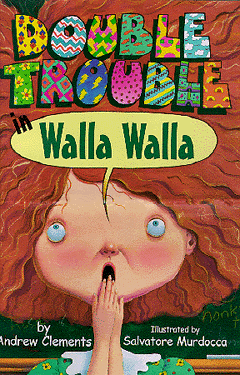
Double Trouble in Walla Walla by: Andrew Clements [fantasy]

In this book a little girl comes to school and she has a question about her homework.  When she opens her mouth to answer the question she says silly phrases.  Her teacher warns her to stop talking in such a silly manner.  Since she can't control what she is saying she continued and her teacher and her went to the principals office.  When her teacher tried to explain to the principal the teacher was talking to silly too. This spread to the teacher, principal, and then the school nurse.  Together they tried to figure out the solution.  They decided to say as many silly things as they could to see if it would fix it.  Sure enough after after pages of jibber jabber the four were cured and their day went on as planned.  This book is good for the class climate.  This book is also good for ELL students who are learning how to read English because it gives them the opportunity to pronouce letter combination in this language.

Saving Sweetness by: Diane Stanley

This book is about a little girl who lives in an orphange.  The foster mother was a horrible lady.  A little girl, the smallest one, left from the orphange and she decided to run into the desert.  The sheriff went into the desert to find her.  The sheriff kept getting himself into trouble and Sweetness kept bailing him out.  Before he would get the opportunity to take her back into town she would run away again.  Sweetness swore to never return to the orphange.  With the help of Sweetness the sheriff caught an outlaw this time Sweetness made the Sheriff promise to adopt her and all three of them went into town.  The sheriff ended up adpoting the entire orphange.  The outlaw married to foster and she was just as mean to him as she was to the children.  The children can write in a journal other ending to the story.  I think this is a good book to stop frequently during readings and have the students predict what will happen next.

Sunday, January 31, 2010

Biography, Autobiography & Non-Fiction

On to the books...


The Cloud Book by: Tomie de Paola [non-fiction]


 I really enjoyed this book. I have already taught a lesson out of this book to 2 classes and I have shared it with my 5 nieces and nephews. It is a hit! The book teaches children about the three major types of clouds and their characteristics. Children learn how to identify the various characteristics of clouds. There are vivid paper machete illustrations. The illustrations in this book will keep children of all ages glued to the book. The authors included a glossary and the scientific name of the clouds in terms that even the youngest of students can understand. It's great! At the end of the book they included a very silly story about clouds which causes the book to end in laughter. A teacher could use this book in their classroom as part of a science lesson. The book provides scientific names to make the book challenging enough for the higher grades. A teacher can do an cloud identifying activity or they could make their own silly story to go at the end of the book including at least one type of cloud.


Different Places, Different Words by: Michelle Kelley [non-fiction]


Kelley uses this book to help children understand that people from different regions do things differently. There is a picture on each page and the author would say something like people from the south say ____ and from the north say ___.  The book has has kinds of things in it from french fries to creeks.  This book is great for English language learners(ELL). The combination of pictures and words is great because it can help the students make a connection. It is better that the book has actual photographs of the item not a drawingm so the student can see close to a real life image. Classrooms with ELL students in it should have this book because it helps other students relate to each other by seeing that even within our nation we have people who call things different than us.  As a teacher you can read the book out loud and have everyone think or journal of a time when people said something different than them and meant the same thing.  You could put this into an ELL students reading bag for extra vocabulary help.


I, Columbus: My journal edited by: Peter & Connie Roop [biography]


This book is recounting of the edventures of Christopher Columbus as he takes his voyage across the Atlantic Ocean.  The book is not written in Old English but it is his journal of the day-to-day encounters that he had with the seaman, the indigineous people, and his personal thoughts and feelings.  This book starts the day they set sail in 1492 and ends the day he landed in the port in which he started his discoveries.  The journals are being kept for the royalty that commissioned him on the trip.  The images that are in the book are drawn by Columbus himself but redrawn by another illustrator.  Even though this book was written by Columbus himself he was not around when it was published so things could have been changed, revised, or left out.  It is best to put biography even though the authors put "Edited by" on the book.   This book is a great for making timelines.  A teacher could have the students keep a journal of the next week or 2 weeks of their life and they could use the book as a guide to do so.  They could use this to later use these journals to attach to story the children could write. This book would be a great addition to a social studies lesson or an activity to do on Columbus Day. 

Realistic or Historical Fiction

Now on to the books:


Kenya's Family Reunion by: Juwanda G. Ford [realistic]


This book is about a young girl named Kenya.  Her entire family travels out to her Grandfather's house each year to their family reunion.  The books tells of some of the traditions that the family has each year. The grandfather bulit his farmhouse himself 50 years before. The children came together to give their Grandfather a special present.  After asking one of their aunts for help the adults of the family decided to join in.  To find out what the amazing gift is have to read the book! :) I think that the book shows that working together you can get things accomplished.  This book is good to read before creating rules for group work.  It shows how you must have a positive attitude.  You can use this book for grandparents day or when the children first come to your grade to lead into the students telling stories about their summer.  This book is great for predicting as well.  This is a great book to do a Me Too! on because the children can make predictions and then agree with others in the class. 


Play Ball, Amelia Bedelia by: Peggy Parish [realistic]


This book is one book in a series of books about Amelia Bedelia.  Amelia takes things very literal.  In this book she walks past a good of boys on the baseball field and they seem upset.  She stops to see what the matter was and they expressed to her how they were going to forfiet a baseball game.  Amelia steps in to help and be the last player that they need but she knows absolutely nothing about baseball.  She makes quite a bit of mistakes like stealing a base by picking it up and run home instead of running to home plate.  At the end of the day Amelia helped the guys win the game and their patience with her was worth while.  This book would make the children laugh and giggle because of Amelia's silly mistakes.  I think it would be a good postive atmosphere book.  Just like the boys in the book had to be patient with Amelia students have to patient with each other and this book is a great way to show that it works out being better in the end.  The students could use this as a writing activity to make an alternate ending to the baseball game.


Everybody Cooks Rice by: Nora Dooley [realistic]


Everybody Cooks Rice is about a little girl looking for her brother for dinner. Her mother sends her to look for him in the nieghborhood.  She knows that her brother likes to go to their neighbors' houses to play.  As she travels from house to house asking if any have seen him while at each house she tastes their dinner.  Each house represents a different nationality or culture.  The families are all eating rice but in different recipies and dishes.  By the end of the story she finds out her brother is at home and she went on a wild goose chase and she is too full it eat the dinner that her mother has prepared.  The book also has little fun facts in the back about different places.  This book is a great diversity book.  It is great for classrooms with different cultures in it.  It shows how we are connected.  Students could ask their parents for a recipe or dish from their house. You could have them look for recipies with one ingredient or you could let them bring back one of their favorite and see what they have in common.  This is a great classroom community building activity. If students are doing a project about Japan this book might help them because it has some interesting fact included.


If You Lived In The Time Of Matin Luther King by: Ellen Levine [historical]


This book is based on various events that happened when some Americans fought for their civil rights.  The book has vivid imagery answers all kinds of questions concerning this time period.  This book is good for Black History Month. The schools children have to opportunity learn about Martin Luther King Jr. but they do not always understand why he chose to live that way.  This book would be a great way to start out any lesson in Black History.  I think that students could think of a question similar to ones that are in the book and do research to find the answer.


A Book about Benjamin Franklin by: Ruth Belov Gross [historical]


This book is about the life of Benjamin Franklin.  The author retold many of the stories adding some parts into it.  The author added dialouge to these events to make his life more like a story. The book starts in his childhood and different things that he does.  The author includes major events like the kite and the key and him making the almanac.  If you were to use this book in your classroom you could use it to make a timeline.  You could have the students try to invent something.  You could tie this book into science curriculm.  The students could get together in groups and talk about their favorite part of the story.

inner child?

i am an aspiring child educator...

one of my professor's is helping my class navigate through the sea of children's literature...

how is she helping us one might ask...

by challenging us to read 20 children's books, 5 catergories, and 2 subcatergories (chapter books & graphic novels)...

the best part...

i have an excuse to read children books...

let's read!...